» The Body at Work: Using Physical Theatre as a Lens on African Labor
This blog post is written by Annie Meyer, who is a graduate student for the Avery Research Center for African American History and Culture during the 2025-2026 academic year. Meyer is a student in the College of Charleston's Theatre department.
In this blog post, I will discuss one of my greatest passions: the use of art, specifically theater, to advocate and educate. I dive into the world of physical theater and how a performance I saw in Arezzo, Italy, called PLANTATION #1, which addressed the devastating realities of forced African labor, not only expanded my perspective as an artist but also as an audience member. I also discuss how working at the Avery Research Center has allowed me to continue this kind of artistry through the research I have conducted here.
What is Physical Theatre?
Physical theatre is a form of theatre that highlights movement and/or visual storytelling rather than dialogue. The history of physical theatre is as old as theatre itself! Ancient Greek theatre (1000 BC-146 BC) utilized masks and physicality in its plays, which catalyzed the development of a vast array of physical theatre variations. These variations would include Indian Koodiyattam, Inuit drum dancing, and Japanese Noh Theatre. 1
In the 20th century, the world witnessed a shift in how the theatre community utilized its platform. Through crisis, an emergence of explicitly political and activist theatre occurred to educate and spark social change. Physical theatre specifically became a highly favorable tool for activism and still is to this day. 2
Uncomfortable Truths in Motion

“the theater of the 1960s and 1970s was not a theater of new plays, or literacy texts interpreted at all, but a theater of new mise-en-scenes—a theater of whole performance texts consisting of movements, stage placement, and tableaux, music (and other sonic elements), visuals including settings, environment, costumes, projections, and a number of nonactor performers: masks, puppets, projections, film.” 3
I was fortunate enough to study physical theatre for a semester at the Accademia dell’Arte ‘Arte (ADA) in Arezzo, Italy. The ADA was a hub for performers to collaborate and educate the young artists who reside there. The reason I decided to write about physical theater for this blog post was inspired by a group that visited the ADA named experi_theatre. 4
They describe themselves as “an experimental performer’s work – identifying specific static elements of political rituals of the reality and investigating designated performative acts in physical actions of performers with the approach of a psycho-physical interiority of the human being.”
When experi_theatre visited the ADA, all we knew was that they would perform a piece called PLANTATION #1. They purposely gave us no context for what the performance would be about to invoke natural thoughts and feelings. They didn’t want the audience to develop personal biases before seeing the show.
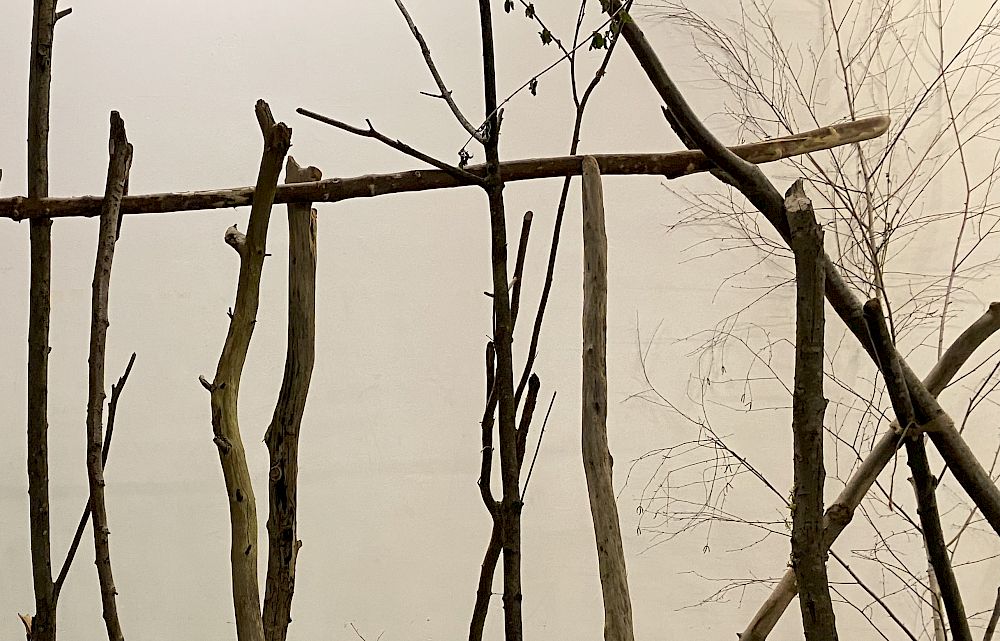
When I walked into the performance space, I immediately felt the show’s mood: dark. There were no seats, so we had to sit on the floor. Real branches were sprawled around, and a tub was in the center of the space. The lights were dimmed. Costumes were nothing complex. The show itself was roughly 90 minutes with no intermission.
PLANTATION #1 addressed the history of the plantation by tracing the past and re-inhabiting the political territory of the plantation, specifically in Sweden, through physical theatre. The actors themselves portrayed the devastating reality of African labor by carrying the large branches that had originally been sprawled on the floor for almost the entire show, as well as sharing real stories about the pain and suffering endured. At the end of the show, they picked a white audience member from the diverse crowd to dump a bucket of water into the tub center stage. The bucket of water represented the sweat and tears of the Africans.
The room went silent, and many deep breaths were taken, including myself, when the lights went down. As an audience member, I truly felt the power of theater in that moment. You don’t need the most elaborate set pieces, costumes, makeup, etc, to create art. You need a story that needs to be told, and sometimes that story is raw and uncomfortable. 5
The Art of Advocacy and Education
Through my time performing and watching numerous theatrical productions, I have observed that the theater industry has shifted towards prioritizing the spectacle of the production over the story itself. Professional theater companies focus on “what would sell?” instead of the original purpose of theater. Theater should be accessible for all, and especially now, more than ever, stories from diverse backgrounds need to be told.
The power of theatre has been recognized for centuries. Riots broke out, governments outlawed the craft, and truths were exposed. That is why theatre should be used as a platform for advocacy and education, as experi_theatre did at the ADA. Physical theatre, with its emphasis on movement, offers a tool for resisting censorship, particularly in contexts where teaching topics such as enslavement is restricted or politically suppressed. Stories that are forbidden in textbooks or silenced in classrooms can be powerfully communicated through choreography, physical metaphors, and visceral performances. This is how physical theatre can reclaim silenced narratives and preserve collective memory through the body itself.
Working at the Avery Research Center has deepened my commitment to using theater as a tool for advocacy and education. As a Graduate Assistant, I’ve had the unique opportunity to engage with archival materials that document the lived experiences, resistance, and cultural expressions of Black communities in the South. I have been specifically drawn to the collection of playwright Carlyle Brown, who clearly intends to include advocacy and education in his plays. This research has not only expanded my historical knowledge but also enriched my artistic practice, reminding me that storytelling, especially through physical theatre, is a powerful way to illuminate truths that are often erased or ignored. The work I’ve done here continues to fuel my passion for creating art that challenges, teaches, and transforms, and affirms my belief that the stage, like the archive, can be a space of both remembrance and revolution.
Footnotes
- A Potted History of Physical Theatre, www.mandy.com/magazine/article/a-potted-history-of-physical-theatre-78508/. ↩︎
- Schechner, Richard. Between Theater and Anthropology. University of Pennsylvania Press, 1985. Accessed at The Avery Research Center for African American History and Culture. ↩︎
- Douglas Turner Ward’s 1966 Production Day of Absence, featuring Robert Dean Hooks and Barbara Ann Terr. Image pulled from the novel International Library of Negro Life. Accessed at the Avery Research Center for African American History and Culture. ↩︎
- Produktionen – Experitheater Zürich<” Experitheater Zürich, www.experitheater.ch/produktionen/. Accessed 3 Nov. 2025. ↩︎
- experi_theater ’s production PLANTATION #1 photo. https://www.experitheater.ch/produktionen/plantation-1/. ↩︎